Inputs
Conditions outside the instrument: data, sound and human interaction.
Lab / inside the instrument
Explore the mechanics behind the encounter. Change one condition. Watch what it makes possible.
01 / Geometry
Repeat a circle around a shared centre. Connections appear between its points. The same relationships can read as a flat pattern or suggest depth.
Repeated circles / connective geometry
This diagram isolates repetition and connection. The artwork adds colour, layering and time to those relationships; it is not simply animating a finished symbol.
02 / Data
Inputs change the conditions under which the system evolves. Here, faster solar wind increases the motion rate. Higher geomagnetic activity shifts the colour and strength of the field.
Simulated inputs · not a live data feed
Input → range → behaviour
Values are mapped into bounded ranges so the work retains its character. This study demonstrates that principle; it is not a scientific visualisation or an exact reproduction of the live engine’s mappings. Live, replayed and simulated inputs should always be identified by their source.
03 / Sound
A small instrument makes the principle audible. Three chords and eight tones all belong to one harmonic language, so separate gestures can overlap without becoming separate sound effects.
Play here, then open the listening bench to hear how nine voices, timing and signal paths shape the full system.
Open the listening bench ↗D major / a playable sketch
Sound begins when you play.
The key, chords and available tones are authored boundaries. Your timing makes the variation. In the full work, nine voices make similar choices within longer cycles and changing conditions.
04 / Presence
Move or touch the diagram to send a disturbance inward. The keyboard pulse button offers the same experiment. Microphone amplitude can expand the field’s rings.
Microphone off · manual controls available
Local input / inward response
This microphone study measures amplitude locally in your browser. Audio is not recorded or sent to a server. It affects this visual diagram only, not the sound blueprint’s harmony or melody. Stop microphone access with the same button.
05 / Space
A projected image and a volume of light have different constraints. In a volume, spacing, viewing angle and the number of light points determine which forms can be read.
The Cube study explores those relationships digitally. It is a model of a possible physical instrument, not a completed installation.
Explore the spatial study ↗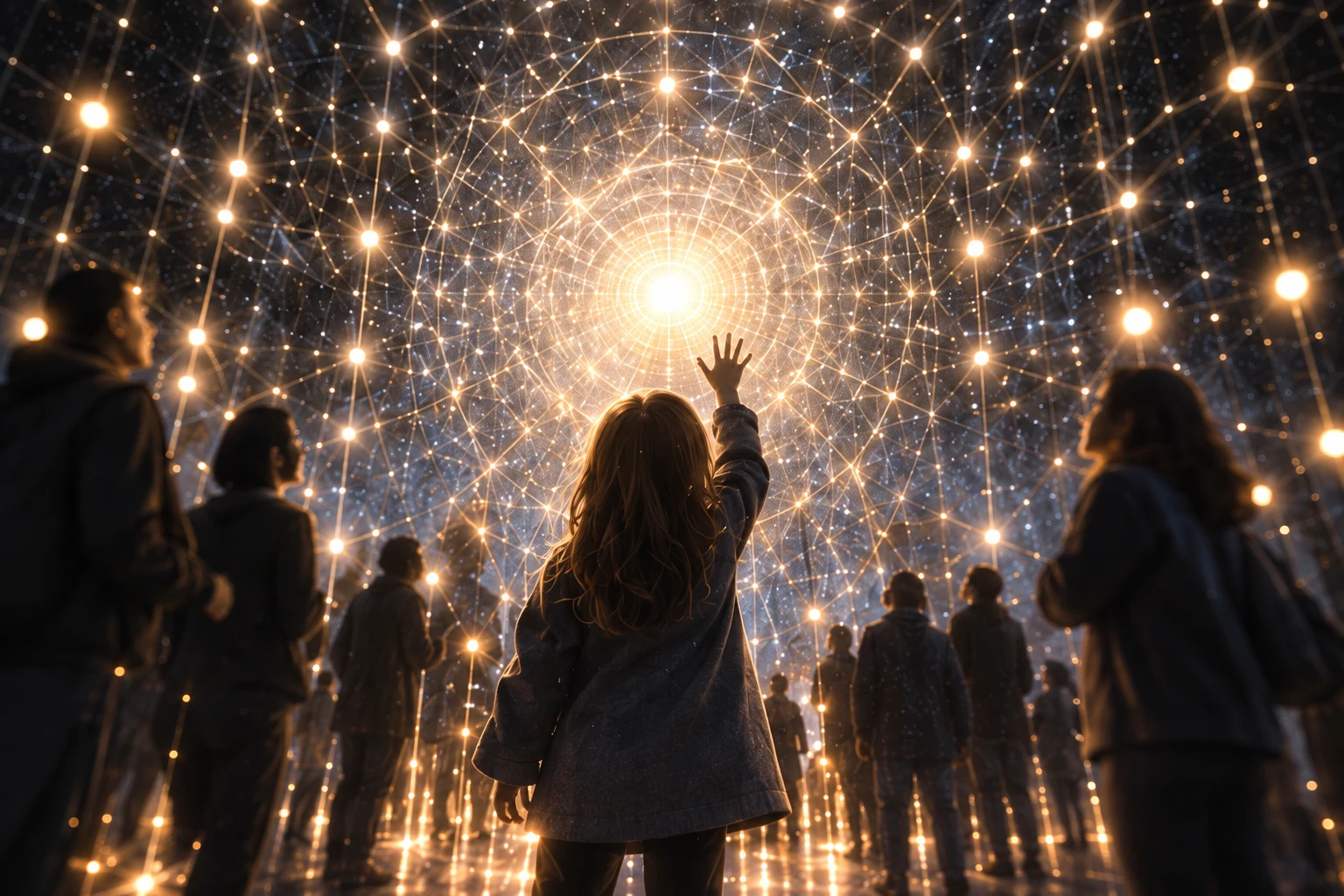
Projection surface, light levels, sound placement and audience distance all change an encounter. Physical work needs a site study, technical testing and production support.
One system / three relationships
Conditions outside the instrument: data, sound and human interaction.
The vocabulary and boundaries that make the work recognisably Emanation.
What emerges through light, form, timing and generated sound.